
Hair on the Financials: How Personal Expenses Quietly Kill Your Multiple
When I speak with owners about selling their business, the conversation usually starts with growth, customers, or industry conditions. It rarely starts with bookkeeping. Yet more often than not, the real issue affecting value is not revenue at all. It is the condition of the financials.
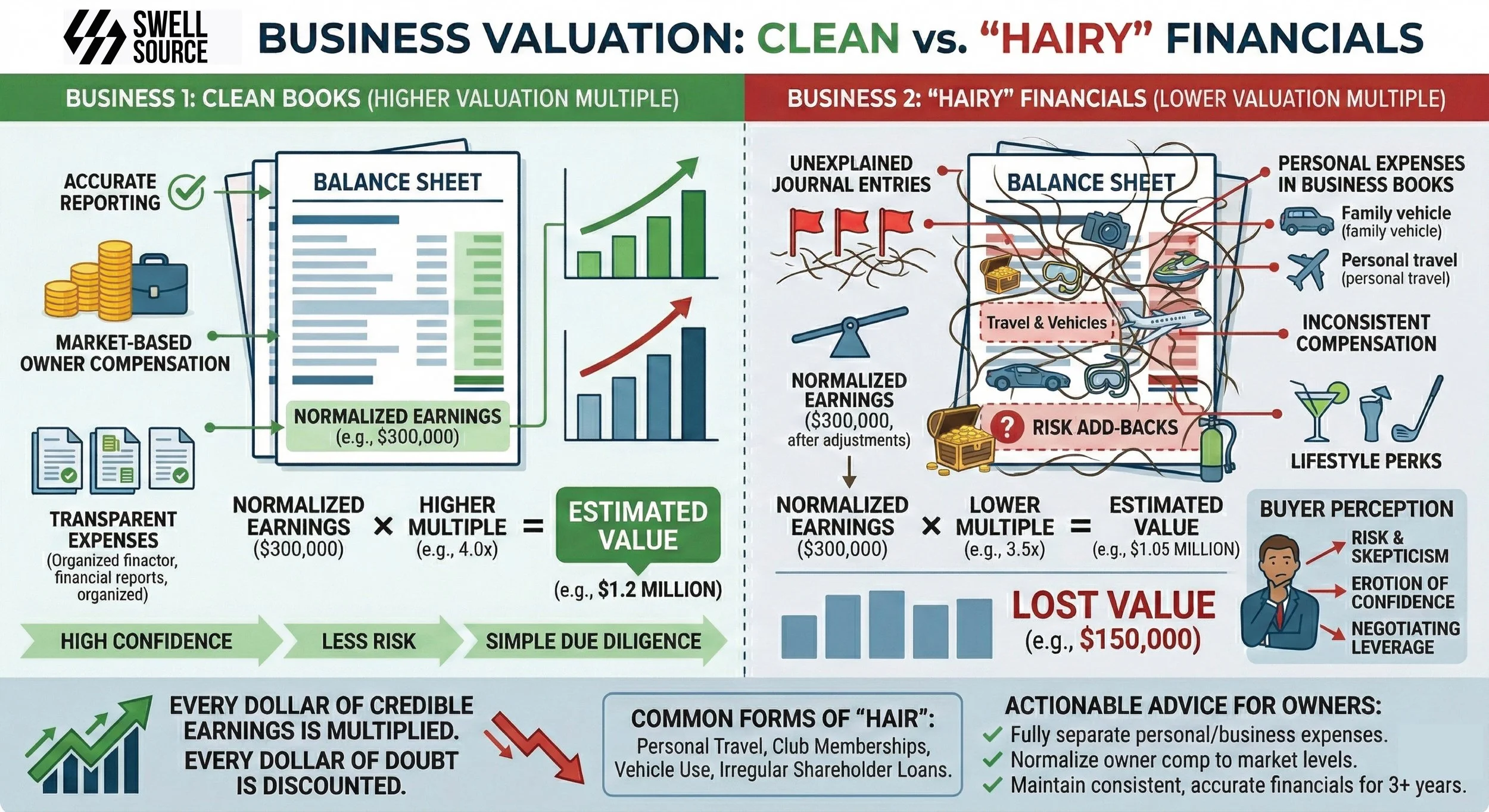
In the M and A world we use a term called “hair” on the financials. It refers to anything in the books that does not reflect the true earning power of the company. Personal expenses running through the business, inconsistent compensation structures, unexplained journal entries, lifestyle perks categorized as operating costs. None of these are unusual in privately held companies. Almost every owner has done some version of it at one time or another.
The problem is not that buyers do not understand this behavior. The problem is that they price the risk it creates.
Most owner operated businesses are valued on a multiple of normalized earnings, typically Seller’s Discretionary Earnings. Buyers are not focused on what the business made historically for you. They are focused on what it will reliably produce under new ownership. The more difficult it is to determine that number with confidence, the more conservative the valuation becomes.
Consider a simple example. Two businesses each show three hundred thousand dollars in profit. One has clean books, market based owner compensation, and consistent reporting. The other has forty thousand dollars of personal expenses buried in travel, vehicles, and discretionary spending. On paper those expenses can often be added back to calculate normalized earnings. In practice, however, buyers begin to question internal controls, discipline, and transparency. That skepticism shows up in the multiple.
At a four times multiple, even a half turn reduction because of perceived risk can translate into well over one hundred thousand dollars in lost value. The issue is rarely the expense itself. It is the erosion of confidence.
Common forms of hair include personal travel categorized as business development, vehicles used primarily for family purposes, club memberships, non essential insurance policies, irregular shareholder loans, and compensation structures that swing materially year to year. None of these automatically kill a transaction. What they do is introduce friction during due diligence and give buyers negotiating leverage.
There is also a broader tension that owners need to think about honestly. Minimizing taxable income and maximizing sale value are not always aligned strategies. Reducing reported earnings may create short term tax efficiency, but business value is derived from defensible, transferable cash flow. When the time comes to sell, buyers and lenders are underwriting normalized earnings, not tax strategy.
If you believe a sale may be part of your future, even several years out, the highest return operational improvement you can make is cleaning up your financial reporting. That means fully separating personal and business expenses, normalizing owner compensation to market levels, reconciling shareholder accounts, and maintaining consistent, accurate financial statements for at least three years. It also means reviewing your earnings periodically through a valuation lens rather than waiting until you are ready to go to market.
Messy financials do not make a business unsellable. They simply reduce leverage and compress multiples. Clean, transparent books signal discipline and transferability. They make buyers more comfortable, lenders more cooperative, and negotiations more straightforward.
Every dollar of credible earnings is multiplied. Every dollar of doubt is discounted.
If you are unsure whether there is hair in your financials, that is a conversation worth having sooner rather than later. A short review today can protect meaningful value when the time to exit arrives.